签名逻辑
为了确保你的支付应用与 SHOPLINE 平台间的访问是安全的、未被篡改的,SHOPLINE 对整个 交易流程 和 商家激活绑定流程 增加了签名验证逻辑。
对于 SHOPLINE 主动请求支付应用的场景,你需要:
- 通过签名算法,验证 SHOPLINE 请求数据的合法性,如果签名验证不通过,不应该处理此次请求。
- 对于返回给 SHOPLINE 的响应数据,确保有按照签名算法进行加签;SHOPLINE 将对响应进行签名验证,如果验证不通过,将不会信任支付应用返回的结果。
对于支付应用主动通知 SHOPLINE 的场景,你需要确保对请求 SHOPLINE 的数据按照签名算法进行加签;SHOPLINE 将对请求内容进行签名验证,如果验证不通过,将不会处理本次请求。
阅读本文,你将了解相关的签名算法及其使用场景。
签名算法
算法简介
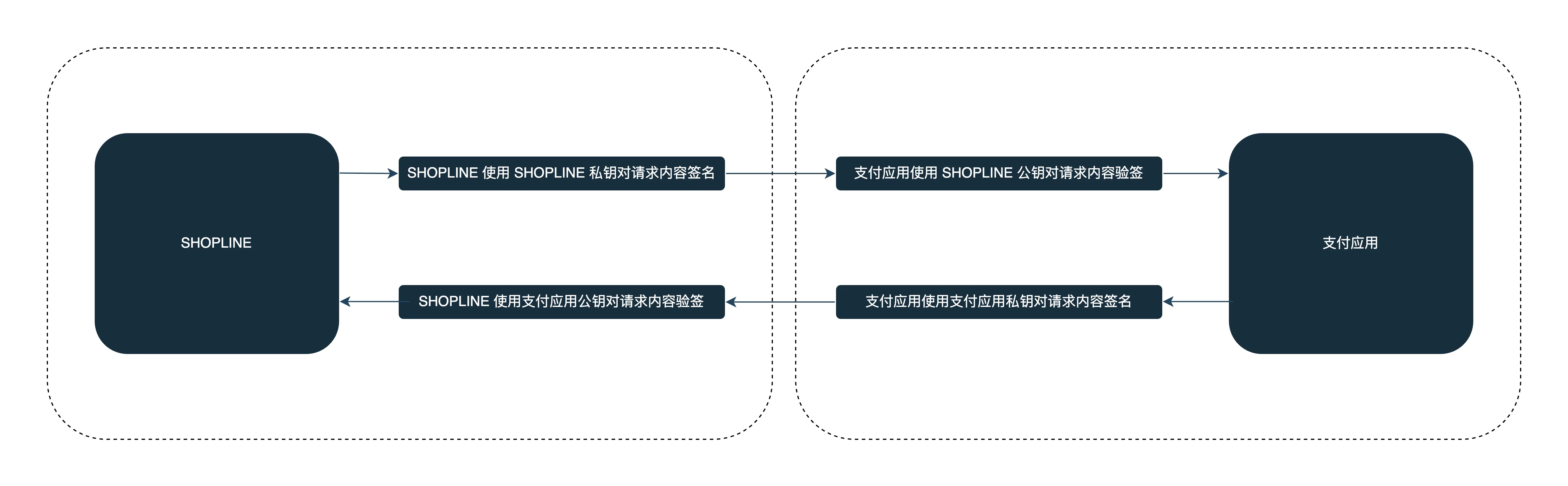
支付应用与 SHOPLINE 平台间的访问使用 SHA1withRSA 算法加密,大体流程如下:
- 在生成 RSA 公私钥时请注意,密钥格式需要使用 PCKS#8,长度需要使用 2048 位。
- 双方需各自持有本人的私钥及对方的公钥,并务必妥善保管私钥,以防泄露导致安全风险。
- 加签时,使用己方私钥进行加签。
- 验签时,使用对方公钥进行验签。
SHOPLINE 公钥获取
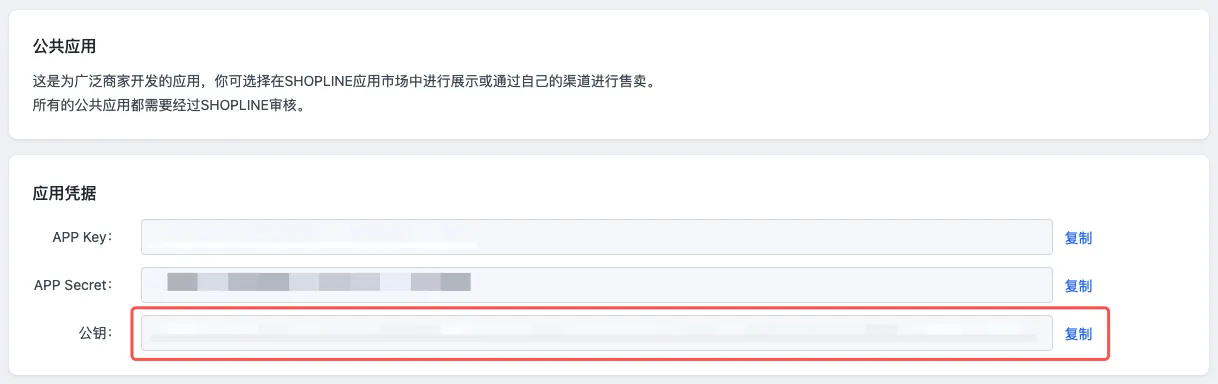
你可以在支付应用首页找到 SHOPLINE 平台的公钥;该公钥用于对 SHOPLINE 发起的请求进行验签,防止第三方伪造请求。
支付应用公钥提交
你需要在 SHOPLINE 合作伙伴后台 > 应用 > 应用详情 > 支付应用拓展 页面提交你的公钥(具体步骤)。SHOPLINE 平台将使用该公钥对支付应用的响应或请求进行验签,防止第三方伪造。
加签与验签
生成待签名文本
加签或验签的第一步,需要将原始报文组装成待签名文本。
生成待签名文本时,要求对参数名进行字典排序,然后使用 = 拼接参数名和参数值,并使用 & 拼接多个参数,即 key1=val1&key2=val2&key3=val3。
- 所有非
null的字段,都需要参与签名。 - 当某个值为复杂类型时,处理规则如下:
- 键值对象:需要将该对象的每一个键值对按组装方式进行递归组装;同时,当前的字段名将会被忽略。
- 列表类型:
- 如果列表中的元素是键值对象,则按键值对象的规则进行递归处理。
- 如果列表中的元素是简单标量,则只需要将列表中的每个元素处理完后,用英文逗号(
,)连接起来。
- 键值对象和列表类型在加入待签名文本时,均不添加
&连接符号。
例如,有以下待签名原文:
{
    "normalKey": "normalValue",
    "emptyKey": "",
    "nullKey": null,
    "list": ["elem1", "elem2"],
    "listObject": [
        {
            "elemKey": "elem1"
        },
        {
            "elemKey": "elem2"
        }
    ],
    "obj": {
        "emptyObjectKey": "",
        "objectKey": "objectValue"
    }
}
则生成后的待签名文本为:
emptyKey=&list=elem1,elem2&elemKey=elem1&elemKey=elem2&normalKey=normalValue&emptyObjectKey=&objectKey=objectValue
代码示例
Java 代码示例:
import org.apache.commons.lang3.StringUtils;
import java.math.BigDecimal;
import java.util.*;
/**
 * 生成签名字符串示例
 */
public class SignatureSourceStringDemo {
    public static void main(String[] args) {
        Map<String, Object> params = new HashMap<>();
        params.put("normalKey", "normalValue");
        params.put("emptyKey", "");
        params.put("list", Lists.newArrayList("elem1", "elem2"));
        params.put("obj", new HashMap<String, Object>() {{
            put("objectKey", "objectValue");
            put("emptyObjectKey", "");
        }});
        params.put("listObject", Lists.newArrayList(
                new HashMap<String, Object>() {{
                    put("elemKey", "elem1");
                }}, new HashMap<String, Object>() {{
                    put("elemKey", "elem2");
                }}
        ));
        String signatureSourceString = buildSignatureSourceString(params);
        System.out.println(signatureSourceString);
    }
    /**
     * 生成待签名的文本
     */
    public static String buildSignatureSourceString(Map<String, Object> params) {
        StringBuilder content = new StringBuilder();
        append(content, params);
        return content.toString();
    }
    private static void append(StringBuilder content, Map<String, Object> sourceObj) {
        if (null == sourceObj || sourceObj.keySet().size() == 0) {
            return;
        }
        List<String> keyList = new ArrayList<>(sourceObj.keySet());
        Collections.sort(keyList);
        for (String key : keyList) {
            Object value = sourceObj.get(key);
            if (value instanceof List) {
                Object itemValue = ((List<?>) value).get(0);
                if (isScalarValue(itemValue)) {
                    content.append(key);
                    content.append("=");
                    content.append(StringUtils.join(((List<?>) value).toArray(), ","));
                } else {
                    for (int i = 0; i < ((List<?>) value).size(); ++i) {
                        Object item = ((List<?>) value).get(i);
                        if (item instanceof Map) {
                            append(content, (Map) item);
                        }
                    }
                }
            } else if (value instanceof Map) {
                append(content, (Map) value);
            } else if (isScalarValue(value)) {
                if (content.length() > 0) {
                    content.append("&");
                }
                content.append(key);
                content.append("=");
                content.append(value);
            }
        }
    }
    /**
     * 检查值是否是标量
     */
    private static boolean isScalarValue(Object value) {
        return value instanceof String
                || value instanceof Float
                || value instanceof Double
                || value instanceof Integer
                || value instanceof Long
                || value instanceof BigDecimal
                || value instanceof Boolean;
    }
}
加签
使用你的私钥,对待签名文本进行加签操作;获取到签名值后,需要在 HTTP Header 中传递:
- 如果是响应 SHOPLINE 的请求,需要在响应头
pay-api-signature中携带签名值;具体字段信息可参考 付款请求。 - 如果是主动通知 SHOPLINE,需要在请求头
signature中携带签名值;具体字段信息可参考 付款状态通知。
代码示例
Java 代码示例:
import java.nio.charset.StandardCharsets;
import java.security.KeyFactory;
import java.security.PrivateKey;
import java.security.Signature;
import java.security.spec.PKCS8EncodedKeySpec;
import org.apache.commons.codec.binary.Base64;
/**
 * 加签示例
 */
public class SignatureDemo {
    private static String priKey ="你的私钥";
    public static final String KEY_ALG_NAME = "RSA";
    public static final String SIGN_ALG_NAME = "SHA1withRSA";
    public static void main(String[] args) {
        String signatureSourceString = "emptyKey=list=elem1,elem2&elemKey=elem1&elemKey=elem2&normalKey=normalValue&emptyObjectKey=&objectKey=objectValue";
        String signature = signWithPrivateKey(priKey, signatureSourceString);
        System.out.println(signature);
    }
    private static String signWithPrivateKey(String privateKey, String signSourceStr) {
        try {
            PKCS8EncodedKeySpec pkcs8EncodedKeySpec = new PKCS8EncodedKeySpec(decodeBase64(privateKey));
            KeyFactory keyFactory = KeyFactory.getInstance(KEY_ALG_NAME);
            PrivateKey myPrivateKey = keyFactory.generatePrivate(pkcs8EncodedKeySpec);
            Signature signet = Signature.getInstance(SIGN_ALG_NAME);
            signet.initSign(myPrivateKey);
            signet.update(signSourceStr.getBytes(StandardCharsets.UTF_8));
            byte[] signed = signet.sign();
            return new String(Base64.encodeBase64(signed));
        } catch (Exception ex) {
            throw new RuntimeException(ex.getMessage(), ex);
        }
    }
    private static byte[] decodeBase64(String sourceStr) {
        return Base64.decodeBase64(sourceStr.getBytes(StandardCharsets.UTF_8));
    }
}
验签
使用 SHOPLINE 的公钥,对待签名文本进行验签操作。
SHOPLINE 只会在主动调用支付应用时,在请求头 pay-api-signature 中携带签名值;具体字段信息可参考 付款请求。
验签时,需要保证 SHOPLINE 传递的所有数据,都已正确地组装到待签名文本;必须先对 SHOPLINE 传递的原始报文验签后,再将其结构化并进行业务逻辑处理,否则会导致验签失败。
为此,SHOPLINE 会在请求中添加随机键值对,来确保使用的是 SHOPLINE 的原始报文进行验签。此机制可以保证后续 SHOPLINE 接口新增参数时(新增的参数一定会参与签名),已对接但未升级的支付应用不会验签失败。
代码示例
Java 代码示例:
package com.example.demo_jdk8.sign.demo01;
import lombok.extern.slf4j.Slf4j;
import org.apache.commons.codec.binary.Base64;
import java.nio.charset.StandardCharsets;
import java.security.KeyFactory;
import java.security.PublicKey;
import java.security.Signature;
import java.security.spec.X509EncodedKeySpec;
/**
 * 验签示例
 */
@Slf4j
public class CheckSignDemo {
    public static final String SIGN_ALG_NAME = "SHA1withRSA";
    public static final String KEY_ALG_NAME = "RSA";
    public static void main(String[] args) {
        String publicKey = "SHOPLINE 的公钥";
        String signatureSourceString = "由 SHOPLINE 响应组装的待签名文本";
        String signature = "SHOPLINE 返回的签名值";
        boolean check = checkSignWithPublicKey(publicKey, signatureSourceString, signature);
        System.out.println(check);
    }
    public static boolean checkSignWithPublicKey(String publicKey, String signSourceStr, String signedStr) {
        try {
            X509EncodedKeySpec bobPubKeySpec = new X509EncodedKeySpec(decodeBase64(publicKey));
            KeyFactory keyFactory = KeyFactory.getInstance(KEY_ALG_NAME);
            PublicKey pubKey = keyFactory.generatePublic(bobPubKeySpec);
            byte[] signed = decodeBase64(signedStr);
            Signature signetCheck = Signature.getInstance(SIGN_ALG_NAME);
            signetCheck.initVerify(pubKey);
            signetCheck.update(signSourceStr.getBytes(StandardCharsets.UTF_8));
            return signetCheck.verify(signed);
        } catch (Exception ex) {
            log.warn("sign check fail, signSourceStr: {}, signedStr: {}", signSourceStr, signedStr, ex);
            return false;
        }
    }
    private static byte[] decodeBase64(String sourceStr) {
        return Base64.decodeBase64(sourceStr.getBytes(StandardCharsets.UTF_8));
    }
}
完整示例
Java 示例
import org.apache.commons.lang3.StringUtils;
import java.math.BigDecimal;
import java.nio.charset.StandardCharsets;
import java.security.KeyFactory;
import java.security.PrivateKey;
import java.security.PublicKey;
import java.security.Signature;
import java.security.spec.PKCS8EncodedKeySpec;
import java.security.spec.X509EncodedKeySpec;
import java.util.*;
public class SignatureDemo {
    public static final String SIGN_ALG_NAME = "SHA1withRSA";
    public static final String KEY_ALG_NAME = "RSA";
    public static void main(String[] args) {
        String privateKey = "你的私钥";
        String publicKey = "你的公钥";
        Map<String, Object> params = new HashMap<>();
        params.put("key", "value");
        String signatureSourceString = buildSignatureSourceString(params);
        String signature = signature(privateKey, params);
        boolean b = checkSignWithPublicKey(publicKey, signatureSourceString, signature);
        System.out.println("b = " + b);
    }
    public static String signature(String privateKey, Map<String, Object> params) {
        String signatureSource = buildSignatureSourceString(params);
        return signWithPrivateKey(privateKey, signatureSource);
    }
    public static String buildSignatureSourceString(Map<String, Object> params) {
        StringBuffer content = new StringBuffer();
        append(content, params);
        return content.toString();
    }
    private static void append(StringBuffer content, Map<String, Object> sourceObj) {
        if (null == sourceObj || sourceObj.keySet().size() == 0) {
            return;
        }
        List<String> keyList = new ArrayList<>(sourceObj.keySet());
        Collections.sort(keyList);
        for (String key : keyList) {
            Object value = sourceObj.get(key);
            if (value instanceof List) {
                Object itemValue = ((List<?>) value).get(0);
                if (isScalarValue(itemValue)) {
                    content.append(key);
                    content.append("=");
                    content.append(StringUtils.join(((List<?>) value).toArray(), ","));
                } else {
                    for (int i = 0; i < ((List<?>) value).size(); ++i) {
                        Object item = ((List<?>) value).get(i);
                        if (item instanceof Map) {
                            append(content, (Map) item);
                        }
                    }
                }
            } else if (value instanceof Map) {
                append(content, (Map) value);
            } else if (isScalarValue(value)) {
                if (content.length() > 0) {
                    content.append("&");
                }
                content.append(key);
                content.append("=");
                content.append(value);
            }
        }
    }
    private static boolean isScalarValue(Object value) {
        return value instanceof String
                || value instanceof Float
                || value instanceof Double
                || value instanceof Integer
                || value instanceof Long
                || value instanceof BigDecimal
                || value instanceof Boolean;
    }
    private static String signWithPrivateKey(String privateKey, String signSourceStr) {
        try {
            PKCS8EncodedKeySpec pkcs8EncodedKeySpec = new PKCS8EncodedKeySpec(decodeBase64(privateKey));
            KeyFactory keyFactory = KeyFactory.getInstance(KEY_ALG_NAME);
            PrivateKey myPrivateKey = keyFactory.generatePrivate(pkcs8EncodedKeySpec);
            Signature signet = Signature.getInstance(SIGN_ALG_NAME);
            signet.initSign(myPrivateKey);
            signet.update(signSourceStr.getBytes(StandardCharsets.UTF_8));
            byte[] signed = signet.sign();
            return new String(org.apache.commons.codec.binary.Base64.encodeBase64(signed));
        } catch (Exception ex) {
            throw new RuntimeException(ex.getMessage(), ex);
        }
    }
    public static boolean checkSignWithPublicKey(String publicKey, String signSourceStr, String signedStr) {
        try {
            X509EncodedKeySpec bobPubKeySpec = new X509EncodedKeySpec(decodeBase64(publicKey));
            KeyFactory keyFactory = KeyFactory.getInstance("RSA");
            PublicKey pubKey = keyFactory.generatePublic(bobPubKeySpec);
            byte[] signed = decodeBase64(signedStr);
            Signature signetCheck = Signature.getInstance(SIGN_ALG_NAME);
            signetCheck.initVerify(pubKey);
            signetCheck.update(signSourceStr.getBytes(StandardCharsets.UTF_8));
            return signetCheck.verify(signed);
        } catch (Exception ex) {
            log.warn("sign check fail, signSourceStr: {}, signedStr: {}", signSourceStr, signedStr, ex);
            return false;
        }
    }
    private static byte[] decodeBase64(String sourceStr) {
        return org.apache.commons.codec.binary.Base64.decodeBase64(sourceStr.getBytes(StandardCharsets.UTF_8));
    }
}
PHP 示例
class SignatureUtilsBySHA1WithRSA {
  public static function genSignatureSourceStr($params){
    $signSourceStr = "";
    $params = json_decode(json_encode($params));
    return self::append($signSourceStr, $params);
  }
  public static function append(&$content, $params){
    $emptyObj = false;
    if(is_object($params) && count(get_object_vars($params))==0){
      return ;
    }
    $params = (array)$params;
    ksort($params);
    foreach ($params as $key => $value) {
      if(is_null($value)){
        continue;
      }
      $prefix = empty($content) ? "" : "&";
      if(is_scalar($value) || empty($value)){
        $content .= $prefix.$key."=".(is_null($value) ? "" : $value);
      }else{
        if(is_array($value)){
          if(empty($value)){
            $content .= $key."=";
          }elseif(is_scalar($value[0])){
            $content .= $key."=".join(",", $value);
          }else{
            if(isset($value[0])){
              foreach($value as $v){
                self::append($content, $v);
              }
            }else{
              self::append($content, $value);
            }
          }
        }elseif(is_object($value)){
          self::append($content, $value);
        }else{
          self::append($content, $value);
        }
      }
    }
    return $content;
  }
  public static function genSignature($toSign, $privateKey){
    $privateKey = "-----BEGIN RSA PRIVATE KEY-----\n" .
      wordwrap($privateKey, 64, "\n", true) .
      "\n-----END RSA PRIVATE KEY-----";
    $key = openssl_get_privatekey($privateKey);
    openssl_sign($toSign, $signature, $key);
    openssl_free_key($key);
    $sign = base64_encode($signature);
    return $sign;
  }
  public static function verifySignature($data, $sign, $pubKey){
    $sign = base64_decode($sign);
    $pubKey = "-----BEGIN PUBLIC KEY-----\n" .
      wordwrap($pubKey, 64, "\n", true) .
      "\n-----END PUBLIC KEY-----";
    $key = openssl_pkey_get_public($pubKey);
    $result = openssl_verify($data, $sign, $key, OPENSSL_ALGO_SHA1) === 1;
    return $result;
  }
}

'%3e%3crect%20x='6'%20y='7.13049'%20width='13'%20height='10'%20rx='1'%20fill='black'/%3e%3cpath%20d='M12.4998%2012.936L-3.65042%200.604835L28.65%200.604838L12.4998%2012.936Z'%20stroke='white'%20stroke-linejoin='round'/%3e%3c/g%3e%3cdefs%3e%3cclipPath%20id='clip0_716_14611'%3e%3crect%20x='6'%20y='7.13049'%20width='13'%20height='10'%20rx='1'%20fill='white'/%3e%3c/clipPath%3e%3c/defs%3e%3c/svg%3e)

'%3e%3crect%20x='5.63086'%20y='7.26086'%20width='13'%20height='10'%20rx='1'%20fill='white'/%3e%3cpath%20d='M12.1306%2013.0664L-4.01956%200.735206L28.2809%200.735209L12.1306%2013.0664Z'%20stroke='%231A2C42'%20stroke-linejoin='round'/%3e%3c/g%3e%3cdefs%3e%3cclipPath%20id='clip0_716_14599'%3e%3crect%20x='5.63086'%20y='7.26086'%20width='13'%20height='10'%20rx='1'%20fill='white'/%3e%3c/clipPath%3e%3c/defs%3e%3c/svg%3e)